I’ve been using Firestore for RateRudder because it is simple, free, hosted for me, and supports subcollections. The subcollections are extremely useful in a multi-tenancy schema because every tenant can have their own set of collections under their namespace. Firestore pricing is based on how many documents you read, write, or delete. The free tier includes 50,000 reads, 20,000 writes, and 20,000 deletes per day. The pricing for Writes and deletes are straightforward, but reads are complicated.
You’re charged at least 1 read for every document scanned in order to fulfill a query, with a minimum of 1 per query. Additionally, you’re charged 1 read for every 1000 index entries except for specific single-field index queries. You’re also charged for non-document queries, like listing collection IDs.
If Firestore happens to be down the Go client will hang waiting for the connection to succeed, or until the context is cancelled. I set up a Cloud Run health check to ensure that a Firestore connection is established and Firestore is responding to queries. That way if there is an issue, Cloud Run can restart my container, or at least not serve any requests. The firestore Go package doesn’t expose any health-related methods and ideally I needed one that didn’t cost me any reads. I assumed that listing collections would only cost a single read which seemed like it was cheap enough. My health check function was simply:
func (f *FirestoreProvider) Ping(ctx context.Context) error {
	if f.client == nil {
		return fmt.Errorf("firestore client not initialized")
	}
	_, err := f.client.Collections(ctx).Next()
	if !errors.Is(err, iterator.Done) && err != nil {
		return fmt.Errorf("failed to ping firestore: %w", err)
	}
	return nil
}
Read Overages
A few weeks later, I was surprised when I started being billed for document reads since I should’ve been well under the 50,000/day limit. I pull up the Usage Insights page which groups your read operations by collection or collection group but there weren’t any collections with more than a couple thousand reads. Next I checked the Query Insights and at the top of the list was COLLECTION * SELECT __collection__. I assumed this was the underlying query behind listing collections but it wasn’t clear why it was costing 7 read operations per execution instead of a single operation. Furthermore, I only had 4 top-level collections being returned.
| Query | Read Operations | Executions |
|---|---|---|
COLLECTION * SELECT __collection__ | 62,496 | 8,928 |
I switched out the code with a query for a non-existent document. Queries are billed a minimum of 1 read even if a document isn’t returned, but even if this document were to exist, it should only cost a single read.
func (f *FirestoreProvider) Ping(ctx context.Context) error {
	if f.client == nil {
		return fmt.Errorf("firestore client not initialized")
	}
	_, err := f.client.Doc("health_check/non_existent").Get(ctx)
	if err != nil && status.Code(err) != codes.NotFound {
		return fmt.Errorf("failed to ping firestore: %w", err)
	}
	return nil
}
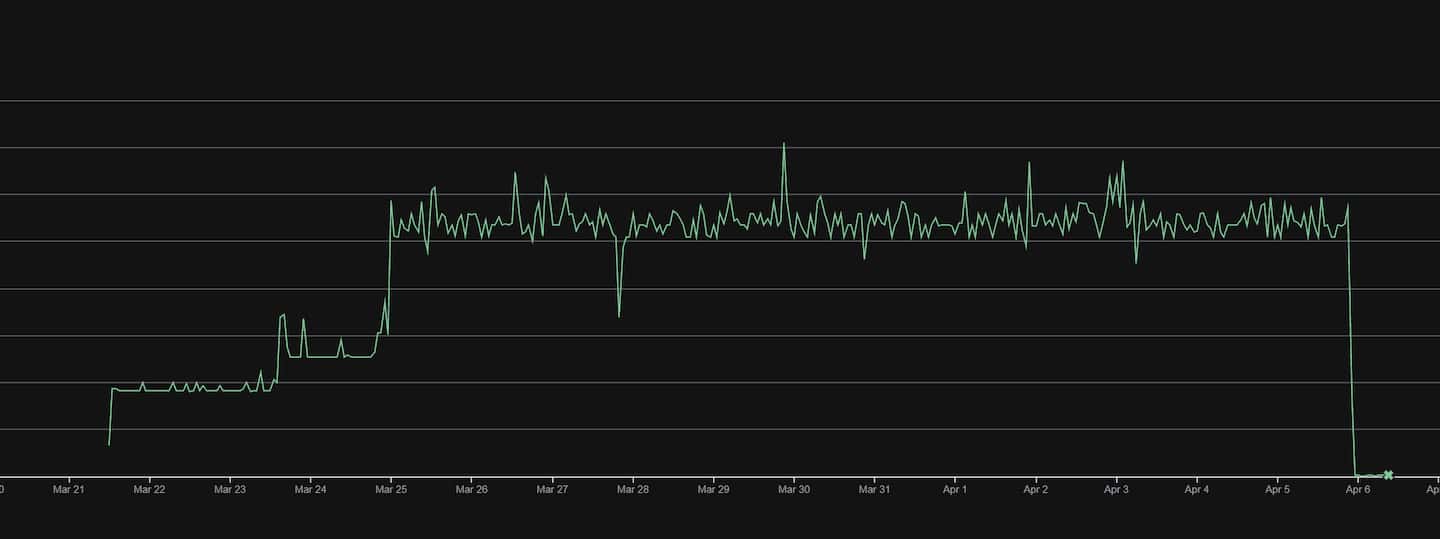
You can see the immediate drop in read operations on April 5th confirming that listing collections was the cause of the excess.
Investigation
Now my reads are under 20,000/day and I’m back within the free tier but I was concerned there was some underlying bug that was causing the excess operations. The Firestore pricing page says:
For queries other than document reads, such as a request for a list of collection IDs, you are billed for one document read. If fetching the complete set of results requires more than one request (for example, if you are using pagination), you are billed once per request.
Maybe the Go client was making a request per collection? I added a gRPC intercepter to log whenever a gRPC request is made:
client, err := firestore.NewClient(ctx, projectID,
  option.WithGRPCDialOption(grpc.WithUnaryInterceptor(
    func(
      ctx context.Context,
      method string,
      req, reply interface{},
      cc *grpc.ClientConn,
      invoker grpc.UnaryInvoker,
      opts ...grpc.CallOption,
    ) error {
      log.Printf("gRPC call: %s", method)
      return invoker(ctx, method, req, reply, cc, opts...)
    }),
  ),
)
This confirmed that the Go client is only making a single gRPC call when calling Collections(ctx).Next(). At this point, I was stumped so I created an empty GCP project, reproduced the issue, confirmed I was billed more than expected on the Usage page, and filed a bug.
I’ll update the post when I hear back from Google.